Introduction
If your beard grows out thick, coarse, or in every direction except the one you want, you already know the routine: fifteen minutes with a blow dryer and a boar-bristle brush, a comb stuffed in your pocket for touch-ups, and a beard that starts curling back up before lunch. That’s the exact problem a heated beard straightener is built to solve, and it’s why Aberlite has become one of the most recognizable names in the category since it launched the first beard-specific straightening brush on Amazon back in 2019.
Disclosure: Glamourora is reader-supported. We use affiliate links to help keep this site ad-free and to support honest, in-depth reviews. As an Amazon Associate, we earn from qualifying purchases at no extra cost to you.
This Aberlite Beard Straightener review looks specifically at how the current lineup performs on thick, coarse, wavy, and curly facial hair — the beard types where a lot of straighteners either underdeliver or start causing real damage. We’ll separate manufacturer claims from third-party hands-on testing and actual customer feedback, and we’ll be upfront about where Aberlite falls short.
Quick Verdict
Buy it if: you have a beard of at least half an inch that’s thick, wavy, or moderately curly, you want salon-style smoothness in under two minutes, and you’re willing to pair it with a heat protectant.
Skip it if: your beard is shorter than half an inch, extremely coily/afro-textured (results will be temporary and heat exposure needs to be minimal), or you’re not willing to manage heat responsibly.
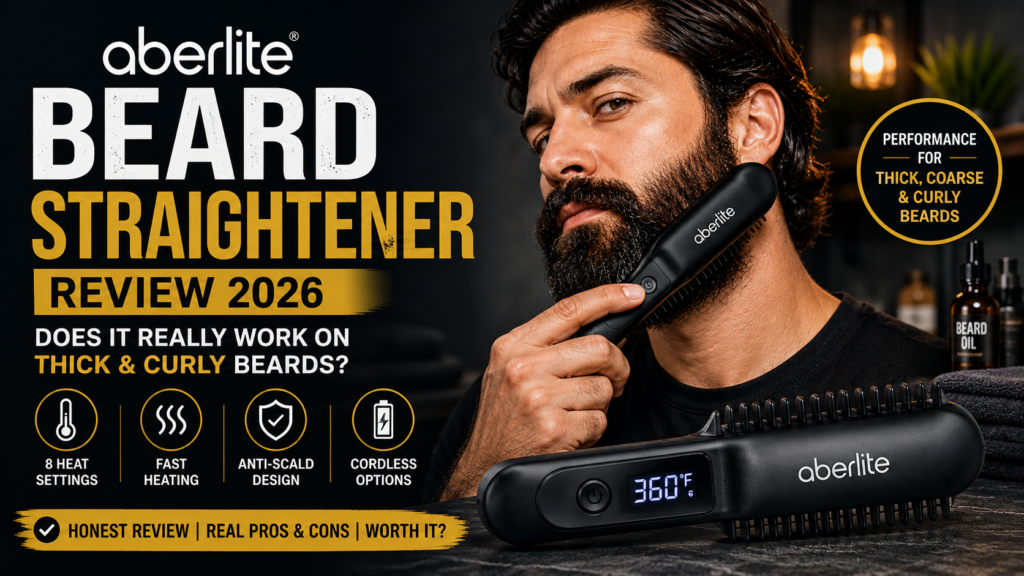
Biggest strength: the Aberlite Pro’s 10-step temperature range (210°F–430°F) gives real control that cheaper straighteners don’t offer.
Biggest weakness: price. At $90–$150 depending on model, Aberlite sits well above budget heated combs, and a small number of buyers report units that stopped regulating temperature correctly.

- Effortless Beard Transformation: Achieve a long, full, and neat beard in minutes. Go from “Caveman” to “Cover of GQ” wit…
- Versatile for All Beard and Hair Types: Shorter, densely packed bristles work perfectly for short, medium, and long bear…
- Safe and Pain-Free: Featuring 2mm Anti-Scald Comb Tooth Technology, it allows you to efficiently straighten your beard c…
Aberlite Beard Straightener at a Glance
Aberlite currently sells three beard straighteners directly on aberlite.com — the Pro, the Slim, and the cordless Go 2 — plus an older compact model, the EDC, that has been phased off the official site but is still sold through Amazon and other marketplaces. Specs below are pulled directly from Aberlite’s current product pages.
| Spec | Aberlite Pro | Aberlite Slim | Aberlite Go 2 |
|---|---|---|---|
| Price | $99 (list $120) | $90 | $127.50 (list $150) |
| Power | Corded | Corded | Cordless (USB-C, 5000mAh) |
| Heat settings | 10 (210°F–430°F) | 8 (250°F–400°F) | 8 (250°F–400°F) |
| Heat-up time | 1 min to 300°F | 1.5 min to 356°F | ~2 min to 300°F |
| Weight | 225g | 193g (lightest) | 410g |
| Bristle columns | 4 | 3 | 5 |
| Battery life | N/A | N/A | 30–60 min/charge |
| Warranty | 2 years | 2 years | 2 years |
Source: Aberlite official product pages (aberlite.com), verified 2026. All three current models use anti-scald 2mm comb-tooth technology and MCH ceramic heating elements, and all are rated for beards of roughly 0.5 inches or longer.
What Is the Aberlite Beard Straightener?
Aberlite makes heated straightening brushes — not flat-plate irons. Instead of clamping hair between two hot plates like a hair straightener, the device uses rows of short, densely packed, heated ceramic-coated teeth that you comb through the beard. The teeth apply heat and tension at the same time, which is what actually straightens the hair, while the wide gaps between rows are designed to reduce the chance of pulling, snagging, or trapping loose skin against the heating element.
This brush-style design is the reason beard-specific straighteners exist as their own category rather than men simply using a flat iron on their face — more on that comparison later in this article.
Does Aberlite Actually Work?
Based on manufacturer specifications, independent hands-on testing, and a broad read of customer reviews, the honest answer is: yes, for most beard textures, with caveats for the most extreme curl patterns.
Grooming publication Beardbrand sent a writer an Aberlite Pro and an earlier Aberlite Go to test firsthand. The tester, who had roughly four months of coarse, wavy beard growth, reported that the Pro reached his chosen 300°F setting in under a minute and straightened his beard within a few passes, with no snagging or pulling, and that the result held for the rest of the day. That’s a genuine third-party account, not a manufacturer claim, and it lines up with the broader pattern in customer reviews: fast heat-up, smooth glide, and noticeable results in one session.
Where results get less consistent is at the curlier end of the spectrum, which is exactly where a lot of competing reviews stay vague. Let’s break it down by texture instead.
Aberlite Performance on Thick & Coarse Beards
This is where Aberlite is strongest. Thick, coarse beard hair generally holds heat-set styles well, and the wider tooth spacing on the Pro and Go 2 (four and five bristle columns respectively) is built to comb through dense growth without snagging. Beardbrand’s tester specifically noted the Pro’s teeth are spaced wide enough to handle a thick beard without snagging the hair.
Practical expectations for coarse/thick beards:
- Expect to make two or three passes per section rather than one, since coarse hair resists heat transfer more than fine hair.
- A heat protectant is genuinely useful here — coarse beards are frequently styled at 350°F+ to get a clean result, which is high enough to warrant one.
- The Pro’s wider temperature range (down to 210°F) gives more room to find the lowest setting that still works, which matters for repeated use.
For a broader shopping comparison across straighteners built specifically for this beard type, Glamourora’s guide to the best beard straighteners for thick beards is worth a look before you commit.
- Effortless Beard Transformation: Achieve a long, full, and neat beard in minutes. Go from “Caveman” to “Cover of GQ” wit…
- Versatile for All Beard and Hair Types: Shorter, densely packed bristles work perfectly for short, medium, and long bear…
- Safe and Pain-Free: Featuring 2mm Anti-Scald Comb Tooth Technology, it allows you to efficiently straighten your beard c…
Does Aberlite Work on Curly Beards?
For moderately wavy to curly beards, Aberlite’s own marketing and third-party testing agree it performs well — this is arguably the core use case the product was designed around, since straight beards don’t need straightening in the first place.
For very curly or tightly coiled (coily) facial hair, the picture is more mixed, and this is a genuine content gap most reviews skip over. Aberlite’s own Amazon product listing for the EDC model carries a direct manufacturer warning worth taking seriously: the company itself states that patchy, curly, coarse, or dense beards may not hold a straightened look for long, and that some hair types need prolonged heat exposure to straighten, which raises the risk of dryness and damage. That’s a rare case of a brand flagging a limitation rather than papering over it, and it should inform how you set expectations.
In practice, for very curly or coily beards:
- Results are typically temporary rather than long-lasting — humidity and natural curl pattern will start pulling hair back toward its original shape faster than on wavy or straight-leaning beards.
- Getting a fully straight result may require higher heat and multiple passes, both of which increase the risk of dryness over repeated sessions.
- A heat protectant and a hydrating beard oil beforehand aren’t optional here — they’re close to essential.
If your beard is on the curlier end and you’re also shopping for pre-styling products, Glamourora’s Honest Amish vs. Viking Revolution beard oil comparison covers two solid options for adding moisture before you reach for any heat tool.
What About Short Beards?
Aberlite’s own specifications set the practical minimum at roughly 0.5 inches across every current model — below that, there simply isn’t enough hair length for the teeth to grip and pull straight. Aberlite states this directly in its FAQ: a beard can technically pass through the device below that length, but the effect won’t be noticeable.
If you’re in the stubble-to-short-beard range and mainly want a faster daily routine rather than dramatic straightening, a compact corded model like the Slim may make more sense than the larger Pro, simply because it’s lighter and easier to maneuver around a smaller amount of hair.
Heat Settings and Temperature Guide
Here’s the current, verified temperature breakdown by model:
- Aberlite Pro: 210 / 250 / 280 / 300 / 320 / 340 / 360 / 380 / 400 / 430°F
- Aberlite Slim: 250 / 280 / 300 / 320 / 340 / 360 / 380 / 400°F
- Aberlite Go 2: 250 / 280 / 300 / 320 / 340 / 360 / 380 / 400°F
Aberlite’s own guidance, echoed by Beardbrand’s independent testing, is to match temperature to hair condition rather than defaulting to the highest setting: lower temperatures for straighter or already-damaged hair, higher temperatures for coarse or very wavy hair that resists styling. Beardbrand’s reviewer specifically found that 300°F was sufficient for his wavy, coarse beard and that he would use an even lower 250–280°F setting in the future to avoid an over-straightened look.
As a general starting framework:
- Fine or straight-leaning beards: 210–280°F
- Medium wavy beards: 280–340°F
- Thick, coarse, or curly beards: 340–400°F, with a heat protectant
- 400°F+: reserve for stubborn, very curly sections only, and avoid holding heat on one spot
This is manufacturer and third-party guidance, not a clinical recommendation — your own beard’s response is the best guide once you’ve tested a session at a moderate setting.
Does Aberlite Damage Your Beard?
Any heat-styling tool carries some risk of damage, and Aberlite is not an exception — the honest answer is that damage risk scales with temperature, exposure time, and frequency, not with the brand you buy.
Independent research on hair heat damage generally points to keeping styling temperatures under roughly 385°F to minimize harm to the hair’s keratin structure and moisture content, and this threshold is one Beardbrand cites directly when discussing the Aberlite Pro’s range. Practical precautions worth following:
- Keep sessions above 380°F short — Aberlite itself recommends avoiding extended use (five-plus minutes) at its highest settings.
- Use a heat protectant spray, especially at 380°F and above. Aberlite sells an Argan-oil-based option for this reason, and Argan oil’s relatively high smoke point makes it a reasonable base ingredient for that purpose.
- Don’t straighten a soaking-wet beard. Aberlite explicitly warns against this — a slightly damp beard (via a water-based mist) is fine, but excess water risks both hair damage and device malfunction.
- Don’t use it daily at high heat indefinitely. Aberlite’s own FAQ acknowledges daily use “might strip the beard of its natural oils” over time and recommends starting low and working up gradually, or limiting high-heat sessions to a few times a week.
None of this is a medical claim — it’s standard heat-styling caution that applies to any thermal tool, beard-specific or otherwise.
How Long Do the Results Last?
In Beardbrand’s testing, the straightened result held for the remainder of the day after a single session. That’s consistent with how heat-set styling generally works on facial hair: it’s a temporary reshaping, not a permanent structural change, and it will start reverting as soon as the beard is exposed to humidity, sweat, or water.
A few realistic expectations:
- Straight or wavy beards tend to hold a straightened style longer — often a full day or more between touch-ups.
- Curlier beards revert faster, sometimes within hours in humid climates.
- A finishing balm or light styling product after straightening (rather than immediately before) helps extend the hold.
- No beard straightener produces a permanent change — if you stop using it, your beard returns to its natural texture.
How to Use the Aberlite Beard Straightener
- Start with a clean, dry (or slightly damp) beard. Aberlite advises against a soaking-wet beard.
- Detangle first. Run a comb or brush through to remove knots before applying heat.
- Apply a heat protectant if you plan to use 380°F or higher, or if you’ll be styling for more than a few minutes.
- Select a temperature appropriate to your beard type using the guide above, starting low if it’s your first session.
- Work in small sections, brushing outward and slightly to the side rather than straight down for more even results.
- Avoid repeated passes over the same spot. Two or three passes per section is normally enough, even for coarse hair.
- Shape the beard with a boar-bristle brush once straightened, while it’s still slightly warm.
- Let the device cool fully before storing or cleaning it.
How to Clean the Aberlite Beard Straightener
This is a genuinely underrated part of ownership. Beard oil, balm, and natural sebum build up on heated teeth over repeated use, and residue left on the comb can affect heat transfer and, over time, hygiene. Aberlite’s official guidance covers three approaches:
- Dedicated cleaning kit (Aberlite’s recommended method): spray the tool cleaner onto the bristles and brush away residue with the included cleaning brush, then wait 10 minutes before powering the unit back on.
- Wet cloth and mild soap, or a disinfecting wipe, for a quick clean between deeper cleanings.
- Cotton swabs dipped in rubbing alcohol, worked between the teeth for buildup in tight gaps.
Important cautions: the device is not waterproof and should never be submerged — water getting into the internal components can damage the heating element. Always unplug (or power off, for the cordless Go 2) before cleaning, avoid harsh chemicals or abrasive scrubbing pads, and let it air-dry or wipe it dry with a soft cloth before storing it in a dry spot. Clean it every one to two weeks with regular use, or sooner if you notice product buildup on the teeth.
- Effortless Beard Transformation: Achieve a long, full, and neat beard in minutes. Go from “Caveman” to “Cover of GQ” wit…
- Versatile for All Beard and Hair Types: Shorter, densely packed bristles work perfectly for short, medium, and long bear…
- Safe and Pain-Free: Featuring 2mm Anti-Scald Comb Tooth Technology, it allows you to efficiently straighten your beard c…
Long-Term Durability
Aberlite backs every current model with a 2-year warranty, which is longer than most competitors in this price bracket and a reasonable signal of confidence in build quality. Beardbrand’s reviewer described the Pro as made from heavy-duty plastic that felt solid and well-constructed, not like a cheap product, and described the Go as similarly sturdy with a soft-touch grip.
That said, customer feedback isn’t uniformly positive on longevity. Scattered reviews across Amazon and eBay listings mention units that stopped regulating temperature correctly after a period of use — including at least one report of a unit whose temperature “never stopped rising,” which is a genuine safety-relevant complaint rather than a minor gripe. These reports appear to be a minority rather than a widespread pattern, but they’re worth factoring into your decision, especially if you plan to use the device unattended for any stretch of time. The most consistent complaint category, beyond isolated defects, is battery-related — for the cordless Go 2, Aberlite’s own support documentation flags faulty third-party charging cables as the most common cause of charging failures.
Given both the isolated defect reports and the standard heat-tool safety practice, don’t leave the device running unattended, and take advantage of the 2-year warranty if you notice any inconsistency in heat regulation.
Aberlite vs. a Regular Hair Straightener
Using a flat-plate hair straightener on a beard is a genuinely bad idea, and this is one of the clearer questions to answer directly:
- Facial-skin proximity: a beard sits directly against the skin of the jaw, neck, and cheeks. Flat irons have exposed hot plates designed for hair that’s held away from the scalp — using one on a beard significantly raises burn risk.
- Comb/teeth design: beard straighteners use spaced, rounded comb teeth rather than flat clamping plates, which is specifically meant to reduce the chance of pinching skin.
- Anti-scald engineering: Aberlite’s 2mm anti-scald comb-tooth technology is designed specifically to let the device get close to the skin without direct contact with the hottest part of the heating element — a feature flat irons simply don’t have.
- Maneuverability: a beard straightener’s smaller head is built to navigate the curves of a jawline and neck; a flat iron is built for long, straight passes through scalp hair.
- Styling outcome: a brush-style tool blends detangling and straightening into one motion, which suits shorter, denser facial hair better than a flat clamp designed for longer head hair.
If you’re also comparing grooming tools for the rest of your routine, Glamourora’s Panasonic Arc5 vs. Braun Series 8 comparison and the Philips Norelco Multigroom 7000 vs. Braun MGK7491 comparison cover the shaver and trimmer side of a complete grooming kit.
Aberlite Pro vs. Slim vs. Go 2 vs. EDC
| Model | Best For | Limitations |
|---|---|---|
| Aberlite Pro | Thick, long, or coarse beards; users who want the widest temperature control and daily-use versatility | Corded only; needs an outlet nearby |
| Aberlite Slim | Anyone who wants the lightest, most maneuverable corded option, including shorter-to-medium beards | Narrower temperature range than the Pro; fewer bristle columns for very dense beards |
| Aberlite Go 2 | Travel, quick touch-ups, and anyone who wants to style away from an outlet | Heavier than the corded models; Aberlite itself recommends against using a cordless unit more than a few times a week to protect battery life and avoid over-styling |
| Aberlite EDC | Ultra-portable everyday-carry use for quick touch-ups; no longer sold on aberlite.com, only through Amazon and other marketplaces | Smaller bristle head means slower sessions on dense beards; sourcing and current warranty support should be confirmed before buying through a third-party marketplace |
Worth flagging as a fact-check note: Aberlite’s older “Pocket” model has since been rebranded and is currently sold as the “Slim” on aberlite.com, with largely the same core specs. If you see the Pocket name referenced in older reviews, it’s describing essentially the same corded, lightweight model now called the Slim.
What Customers Like About Aberlite
- Speed: heat-up times of roughly one minute and total styling sessions of two minutes are the single most repeated praise point across reviews.
- Smooth glide: customers consistently describe minimal snagging, even on thicker beards, which lines up with the wide comb-tooth spacing.
- Temperature control: the range of heat settings, particularly on the Pro, is called out as more versatile than cheaper competitors.
- Warranty and support: the 2-year warranty and 30-day money-back guarantee come up frequently as a reason customers felt comfortable buying at this price point.
- Effortless Beard Transformation: Achieve a long, full, and neat beard in minutes. Go from “Caveman” to “Cover of GQ” wit…
- Versatile for All Beard and Hair Types: Shorter, densely packed bristles work perfectly for short, medium, and long bear…
- Safe and Pain-Free: Featuring 2mm Anti-Scald Comb Tooth Technology, it allows you to efficiently straighten your beard c…
What Customers Don’t Like
- Price: at $90–$150, Aberlite is priced well above generic heated combs, and this is the most consistent negative theme across review platforms.
- Isolated durability complaints: a minority of reviewers report units that develop heat-regulation issues after a period of use.
- Cordless charging friction: some Go 2 owners report charging problems, which Aberlite attributes primarily to third-party cables and chargers rather than the unit itself.
- Curly-beard limitations: as covered above, results on very curly or coily beards are less dramatic and less durable than on wavy or coarse beards — a limitation Aberlite itself acknowledges.
Pros and Cons
Pros
- Fast heat-up (as little as 60 seconds)
- Wide temperature range on the Pro (210°F–430°F)
- Anti-scald comb design built specifically for facial hair
- 2-year warranty across the current lineup
- Cordless option (Go 2) for travel
Cons
- Premium price versus budget straighteners
- Not effective on beards under ~0.5 inches
- Limited, temporary results on very curly/coily beards
- A minority of reports of heat-regulation defects
- Cordless model needs recharging and isn’t meant for daily heavy use
Who Should Buy Aberlite?
- Men with thick, coarse, or dense beards who want faster, more controlled styling than a blow dryer and brush
- Men with long or wavy beards who want a straighter, more uniform look before trimming
- Men who travel frequently and want a compact or cordless option
- Anyone who wants a wider, more precise temperature range than budget straighteners typically offer
Who Should NOT Buy Aberlite?
- Men with beards shorter than roughly half an inch — there isn’t enough length for the teeth to grip
- Anyone expecting a permanent texture change rather than a temporary, heat-set style
- Buyers unwilling to use a heat protectant or manage session length on high settings
- Very curly or coily beard types expecting all-day hold without touch-ups
Is the Aberlite Beard Straightener Worth It?
For thick, coarse, and wavy-to-moderately-curly beards — the audience this article is written for — Aberlite is a genuinely solid pick within the beard-straightener category, backed by both manufacturer specs and independent hands-on testing showing fast, effective, low-snag results. The Pro in particular earns its price through temperature range and versatility that budget alternatives don’t match.
Where the recommendation softens is for very curly or coily beards, where even Aberlite’s own materials acknowledge the results won’t be as dramatic or long-lasting, and for buyers on a tight budget who might be better served starting with a cheaper heated comb before committing to a $90–$150 tool. The isolated but real reports of heat-regulation issues are also worth weighing against the 2-year warranty that backs every current model — it’s a real safety net, but it means you should register your purchase and keep an eye on how the unit performs in the first few uses.
- Effortless Beard Transformation: Achieve a long, full, and neat beard in minutes. Go from “Caveman” to “Cover of GQ” wit…
- Versatile for All Beard and Hair Types: Shorter, densely packed bristles work perfectly for short, medium, and long bear…
- Safe and Pain-Free: Featuring 2mm Anti-Scald Comb Tooth Technology, it allows you to efficiently straighten your beard c…
Frequently Asked Questions
Does the Aberlite Beard Straightener really work?
Yes, for most beard textures — thick, coarse, and wavy beards respond especially well, based on both manufacturer testing and independent hands-on reviews. Results are less dramatic and less durable on very curly or coily beards.
Is Aberlite good for thick beards?
Yes. The wider comb-tooth spacing and multi-column bristle structure on the Pro and Go 2 are specifically designed to comb through dense growth without snagging, though thick beards may need two or three passes per section.
Does Aberlite work on curly beards?
It works, but with caveats. Moderately wavy to curly beards straighten well. Very curly or coily beards will straighten temporarily but revert faster, and Aberlite’s own product materials note that patchy, curly, coarse, or dense beards may not hold results as long.
What temperature should I use on my beard?
Start low — around 250°F–280°F for finer or straighter beards, and work up to 340°F–400°F for coarse or curly hair, using a heat protectant above 380°F. Aberlite and independent testers both recommend against defaulting to the maximum setting.
Can Aberlite damage beard hair?
Any heat tool can cause damage with excessive temperature or overuse. Staying under roughly 385°F for daily use, using a heat protectant at higher settings, and avoiding repeated passes over the same section all reduce the risk.
Can I use beard oil before a beard straightener?
Yes, and it’s generally recommended — a light oil or heat protectant helps reduce friction and moisture loss during styling. Just avoid straightening a beard that’s soaking wet.
How often can I use a beard straightener?
Aberlite suggests starting with a few sessions per week rather than daily use, particularly at higher temperatures, and increasing frequency gradually based on how your beard responds. For the cordless Go 2, Aberlite specifically recommends no more than a few uses per week to protect the battery and reduce over-styling risk.
Is Aberlite better than a regular hair straightener?
For facial hair, yes. A beard straightener’s comb-style design and anti-scald engineering are built for the close proximity of a beard to facial skin, which a flat-plate hair straightener is not designed to handle safely.